
Why Connor Hellebuyck Should Be the Blueprint for Youth Sports in America
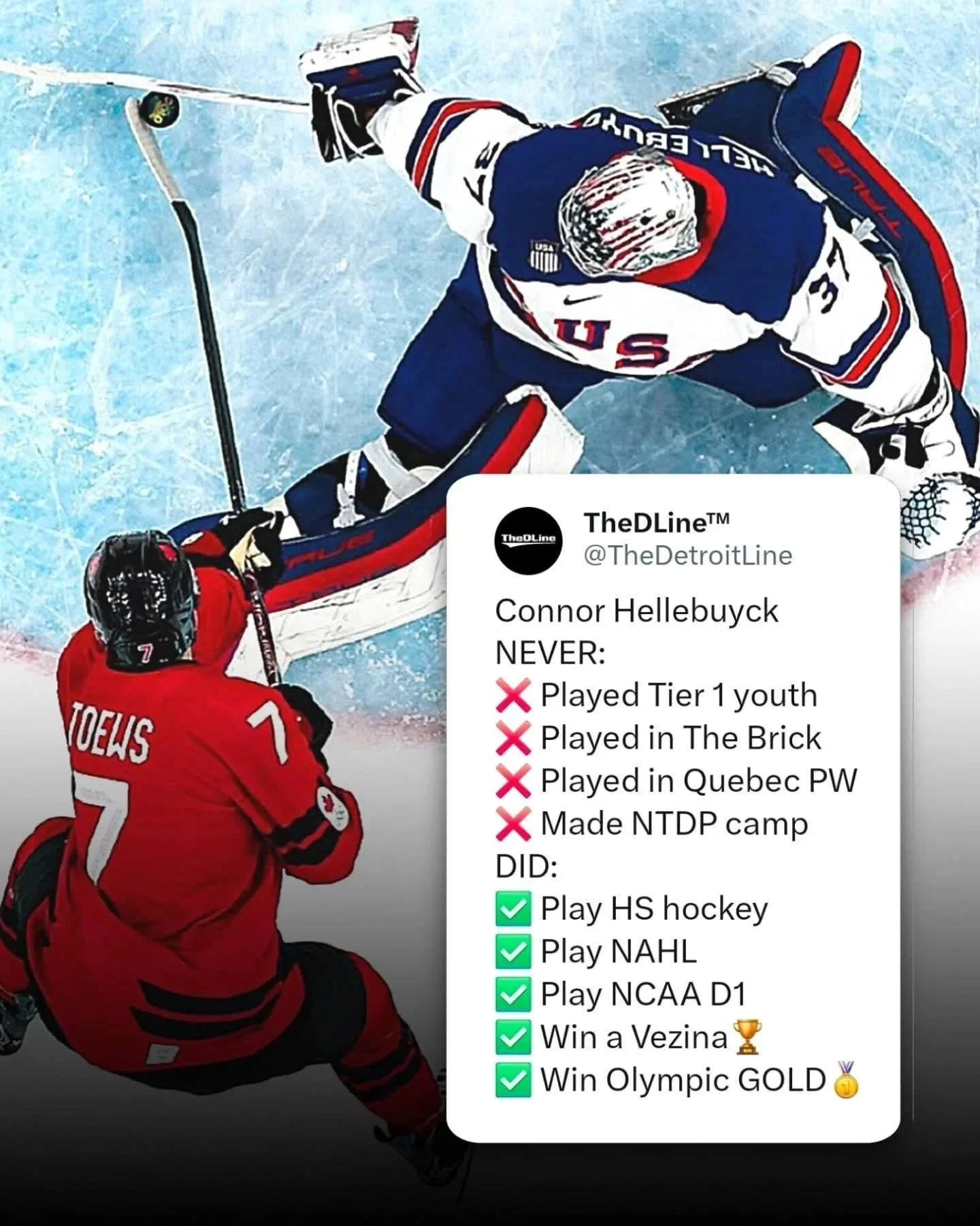
Everyone around the country just watched one of the greatest goaltending performances we’ve ever seen, capped by what is the best save in American hockey history given the moment. Team USA stood on top of the hockey world, and like so many others, I’m proud of that moment. I’m proud of what was accomplished, proud of the players, and proud of the result.
But pride shouldn’t prevent us from being honest.
We should not confuse Team USA’s Olympic success with the current state of youth hockey in America. Doing so creates a false sense of security and ignores what is happening at the grassroots level. In fact, if we’re being truthful, the very goalie who just helped deliver a gold medal for the United States likely would not have had the opportunity to become who he is in today’s youth sports landscape.
Connor Hellebuyck should force us to have an uncomfortable conversation.
Hellebuyck did not play AAA hockey. He did not play in the USHL or any other Tier I junior league as he was never drafted or offered the chance. He was not invited to the NTDP camp. He was passed over in his first year of NHL draft eligibility and was the 13th goalie taken in the 2012 NHL Draft.
The reality is this: in the current landscape, Connor Hellebuyck likely would never have been given a real shot. Even 15 years ago, he was barely given a shot. He just happened to make the most of it time and time again because he has now proven he is the best in the world. But today, we would likely never know Connor’s name and he would not get a chance to play simply because his youth and junior resume aren’t what people think it needs to be. It has nothing to do with skill, simply access and how many A’s are next to your teams name.
Connor Hellebuyck didn’t play AAA because his family couldn’t afford it—a reality that countless American families face today. He luckily developed during a time when AAA hockey hadn’t quite yet taken over youth development the way it has now. Today, if you don’t pay $20,000 or more per year, travel constantly, hire advisors, and align yourself with the “right” programs and people, your path narrows dramatically. Unless you’re fortunate enough to live in places like Minnesota, where community-based hockey still thrives, access has become the defining factor.
We are no longer developing the best players.
We are developing the players who can afford to play.
If we truly want to grow the game, this has to be a serious topic of discussion. Right now, we are pricing kids out for no reason other than greed and fear of missing out. That should concern everyone who claims development is the priority.
Science has already given us the answers. Long-term athlete development research consistently shows that early specialization is not necessary—and often harmful. Countries like Norway, which produces world-class athletes across multiple sports and recently led the Winter Olympics in medals, don’t push competitive sports until around age 12. Before that, kids are encouraged to play multiple sports, explore movement, and simply be kids. Why? Because it is scientifically proven that this develops the best athletes long term.
USA Hockey, to its credit, says the right things. I know this because I’ve been through it. I hold a Level 4 certification, I’ve attended countless clinics, and I’ve studied human development as part of my graduate work. The problem isn’t a lack of information—it’s a lack of alignment. Our actions completely contradict the science we claim to believe in.
I’ve been coaching for about seven years now, and I’m not a parent. I don’t have skin in the game, which allows me to view things through a more objective lens. What I’ve seen play out in real time matches exactly what the research predicts. I’ve watched kids who were labeled “elite” at six years old—kids who played on top teams and were billed as the next great thing—end up on the same playing field at 14 as kids who didn’t start travel hockey until they were 11 or 12. I’ve heard parents proudly talk about their child scoring 60 percent of their team’s goals at Squirt, only to watch that same player contribute 10 percent a few years later.
This isn’t anecdotal. It’s predictable. And it’s backed by science.
So if we know this, why are we professionalizing youth sports?
Why do we see 8U Mite teams playing full-ice games, traveling six to eight hours regularly, and spending every waking moment focused on hockey instead of being kids? Why do we see 12U Tier II teams effectively billeting players or associations changing rules to create “super teams”? The answer comes from two places, and both share responsibility.
First, associations and coaches have gone off the rails. USA Hockey sets development standards based on the science we know that are routinely ignored, and there is little accountability when those standards aren’t followed. How many 10U travel teams stick to the recommended number of games (which is about 30 games)? The answer is nearly zero, and in fact, is nearly double or more in most cases. Second, parents are terrified of missing the boat. They’ve been convinced that if their child doesn’t get in at seven years old, the door will close forever. In some cases, that fear isn’t entirely unfounded due to association politics—and that, too, is part of the problem.
The result is a system that waters down local programs, forces families out due to cost, and actively harms grassroots hockey. It does the opposite of what it claims to do. We know that the more kids who play, the more opportunities there are to develop elite athletes long-term. And even for the other 99.9 percent who won’t reach the pinnacle of the sport, those kids become the next generation of leaders, parents, coaches, and advocates who keep the game alive.
The cost of this system isn’t just financial. It’s developmental. It’s mental. It’s physical. And it’s cultural. We are shrinking the talent pool and burning kids out before they’ve had a chance to truly grow.
I’ve heard the argument that Connor Hellebuyck is an outlier—that there will always be exceptions. My response is simple: he shouldn’t be.
Connor Hellebuyck should be the blueprint.
We should normalize and encourage local, community-based Tier II hockey through at least Peewee, at an absolute minimum. There is no scientific justification for AAA hockey before Bantam age. None. We should reduce the number of so-called “AAA” programs that simply add an extra letter to their name to extract thousands of dollars from families and change the culture that if you don’t play AAA, you aren’t worthy or don’t deserve a chance. USA Hockey’s newly approved Development League may be a step in the right direction, but it needs strong oversight, cannot price people out if it truly cares about long term development, and is just the first step in the right direction. We have far more to do.
Players shouldn’t be forced into a single-sport box at six, seven, or eight years old. Players who don’t make AAA at 13, 14, or even 15 (for financial or even skill reasons) shouldn’t have the door slammed shut on them. Most people would agree with this in principle, yet our actions continue to completely contradict it. Are we that caught up in status? That afraid of missing out? That unwilling to confront corrupt, for-profit systems?
If we want to grow the game, this has to change. If we want to develop the best athletes in the world, this has to change. Right now, we are on track to produce the best athletes who can afford to play—not the best athletes who can play.
We need to look at Connor Hellebuyck’s path and say this should not be the exception. It should be the rule. Every kid should have a legitimate chance to develop into the best athlete they can be if they have the love for the game, the drive, and the skill to compete at the highest levels. We don’t need to compete at the highest levels and professionalize 8 year old hockey, but at 16, 17, 18, etc. when it actually matters. Everyone should be given this opportunity because nobody in the world can look at an 8-10 year old and accurately predict them to be the next Olympic athlete. Sometimes they may be right, but most of the time they will be wrong, because science proves so.
We need to stop saying the right things and start doing the right things. We need to stop pouring money into labels and get back to the grassroots. Let kids play other sports. Let them develop. Let them be kids. This isn’t about a lack of competitiveness. I personally hate to lose more than I love to win, but I can look through the lens of reality and see the toxic culture we are creating. It’s completely unnecessary, and a detriment to the health of families and youth across America in all sports. Sports are an outlet to have fun, learn new skills, be physically active, and be a vehicle to learn valuable life lessons. Sports are not supposed to be a vehicle of constant stress and angst, one where you have to choose between your kid playing AAA Hockey or making your house payment.
Connor Hellebuyck’s path shouldn’t be the road less traveled.
It should be our interstate.
